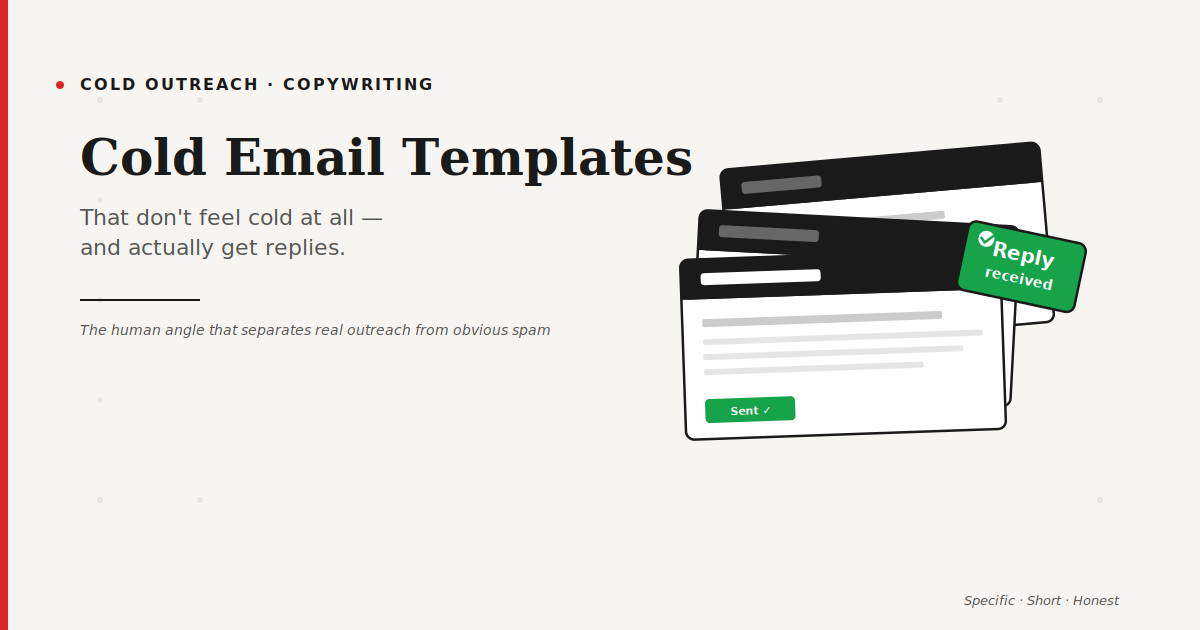
Cold Email Templates That Don't Feel Like Cold Emails
I got a cold email last month that started with: "Hi [FIRST_NAME], I hope this email finds you well."
I laughed. Then I deleted it. Then I felt slightly sad for whoever sent it, because someone, somewhere, thinks this still works.
The reason cold emails have such a terrible reputation isn't because cold outreach is bad. It's because 95% of cold emails are written like spam. Stiff. Generic. Obsessed with the sender's product. Zero effort to understand the recipient.
The best cold emails don't feel cold at all. They feel like a message from someone who actually thought about you before clicking send. Here's how you write them.
Why Most Cold Email Templates Fail
Before we get to the templates, let me explain what's broken with the usual approach.
Most cold email templates are written to be scalable, not to be read. They're optimized for volume, not reply rate. They open with formalities nobody cares about. They pitch in the first paragraph. They ask for a 15-minute call from a stranger in the first email. They sound like every other cold email in the inbox.
The mailbox providers have noticed. Gmail, Outlook, and Apple Mail all use AI to spot these patterns. Same phrases. Same structure. Same push toward a meeting. Those emails don't just get ignored by humans — they increasingly get filtered to spam before humans even see them.
The fix isn't a better template. It's a better philosophy. Write like you're emailing one specific person, because you are.
The Anatomy of a Cold Email That Works
Every great cold email I've ever seen or sent has the same bones.
A subject line that sounds like a normal email. Not a headline. Not a pitch. Something you'd write if you were messaging a colleague.
A first line that proves you know who they are. One sentence that shows you spent 30 seconds actually looking at their work, company, or recent activity.
A clear, short reason you're reaching out. No buildup. No throat-clearing. Why are you in their inbox?
A low-friction ask. Not "15-minute demo." Something smaller. "Worth a reply?" "Does this resonate at all?" "Is this something you'd even want to explore?"
A sign-off that sounds like a person wrote it. Not "Best regards," with a four-line signature and three legal disclaimers.
Template 1: The Specific Observation
Best for: B2B outreach where you've researched the company.
Subject: Quick thought on your pricing page
Hi Marcus,
Saw you moved your pricing tiers off a separate page and onto the homepage last week. Interesting move — I noticed ConvertKit did something similar and saw a bump in conversions.
We help SaaS teams test pricing display patterns without having to rebuild their site. Curious if that's something on your radar, or if you've already nailed it.
Either way, the redesign looks clean.
— Reda
Why this works: the first line is specific. You actually looked at their site. You're not pretending to be their friend, you're showing you did the work.
Template 2: The Honest Ask
Best for: When you don't have deep research, but you have a relevant offer.
Subject: Worth a 2-minute read?
Hi Sarah,
Quick and honest: I don't know you, and you don't know me. I'm reaching out because we built something that I think solves a specific pain for companies like yours — managing multi-language content without five separate CMSes.
I could send you a deck. I won't. If you're curious, I'll send a 90-second Loom of the exact feature I think would help. If you're not, totally fine, and I'll leave you alone.
Worth a reply?
— Reda
Why this works: it acknowledges the awkwardness of cold outreach, which disarms the recipient. It respects their time. The ask is tiny.
Template 3: The Useful Giveaway
Best for: When you can give them something valuable upfront, no strings.
Subject: Noticed something on your checkout flow
Hi Jamal,
Was signing up for a trial on your site to check it out (actually liked it) and hit a small friction point on step 3 of checkout — the form didn't remember my info after I validated my email, so I had to re-enter.
Recorded a quick screen share in case it's useful: [link]
No ask here. Just thought you'd want to know.
— Reda
P.S. I do run a small agency that helps with this kind of thing, but genuinely, no agenda on this email.
Why this works: you gave first. You pointed out something useful. The P.S. is honest about who you are without being pushy. Most recipients reply to this, because giving a free insight breaks every expectation they have of cold email.
Template 4: The Follow-Up That Doesn't Beg
Best for: When your first email got no reply. Which will be most of the time.
Subject: (thread)
Hi Marcus,
Probably buried in your inbox. If this isn't a fit or isn't the right time, a quick "not now" is totally fine and I'll stop bothering you.
— Reda
Why this works: three sentences. No rehash of the original pitch. Gives them permission to say no easily. People respect that, and many will actually respond just because you made it painless.
What Separates Good Cold Email From Bad
I've read thousands of cold emails over the years. The ones that convert share a handful of traits.
They're short. Under 120 words, usually. Long cold emails are an insult to the reader's time.
They're specific. Generic cold emails can be detected in the first sentence. If your email could be sent to 5,000 people with a name swap, it's not going to land.
They don't oversell. The worst cold emails are the ones making massive claims ("10x your revenue!") from a stranger. Nobody believes them.
They don't ask for much. The smaller the ask, the more likely the reply.
They sound like a human wrote them at their desk, not a SaaS tool from a template. Little imperfections — a casual phrase, a parenthetical, a P.S. — actually help.
The Follow-Up Cadence That Works
One cold email almost never gets a reply. That's normal. The sequence is where the replies come from.
My standard cadence: Day 1 (initial email), Day 4 (light follow-up), Day 10 (different angle), Day 20 (final breakup email), done. Four touches. Spread out. Each one shorter than the last. Then I stop.
Stalkers send 8 emails in 10 days. Don't be that person. It doesn't work and it ruins your domain reputation fast.
A Word on Deliverability
None of these templates matter if your emails end up in spam. Cold email, in particular, is heavily scrutinized by mailbox providers. Before you send a single campaign, make sure your domain is authenticated (SPF, DKIM, DMARC), warmed up properly, and sending from a dedicated outreach domain — not your main business domain.
And run your list through an email checker first. Sending to invalid addresses is the fastest way to get flagged as a spammer, no matter how good your copy is.
Final Thought
The secret of good cold email is that it isn't really a template. It's a mindset. You're writing to one specific human who has a full inbox, a busy day, and no reason to care about you yet.
Give them a reason. Be specific. Be short. Be honest.
Then hit send, and move on. The replies will come.
FAQ: Cold Email Templates
How long should a cold email be?
Under 120 words, ideally. Anything longer and most recipients won't finish it. Short cold emails consistently outperform long ones.
What's a good reply rate for cold email?
A well-targeted cold email campaign with good copy averages 5-15% reply rates. Anything above 10% is excellent. Below 2% usually means your list or your message is off.
Is cold emailing legal?
In B2B contexts in most countries, yes, provided you follow the local regulations (CAN-SPAM in the US, GDPR in the EU, CASL in Canada). You typically need a valid unsubscribe mechanism and an accurate sender identity.
How many follow-ups should I send?
3 to 4 is the sweet spot. After that, you're just annoying people. The last follow-up should be a polite breakup email that gives them an easy way to say no.
Should I personalize every cold email?
The opening line, absolutely. The body can be templated. Pure mass-blast cold emails don't work anymore. One specific, researched sentence at the top of each email makes a huge difference.